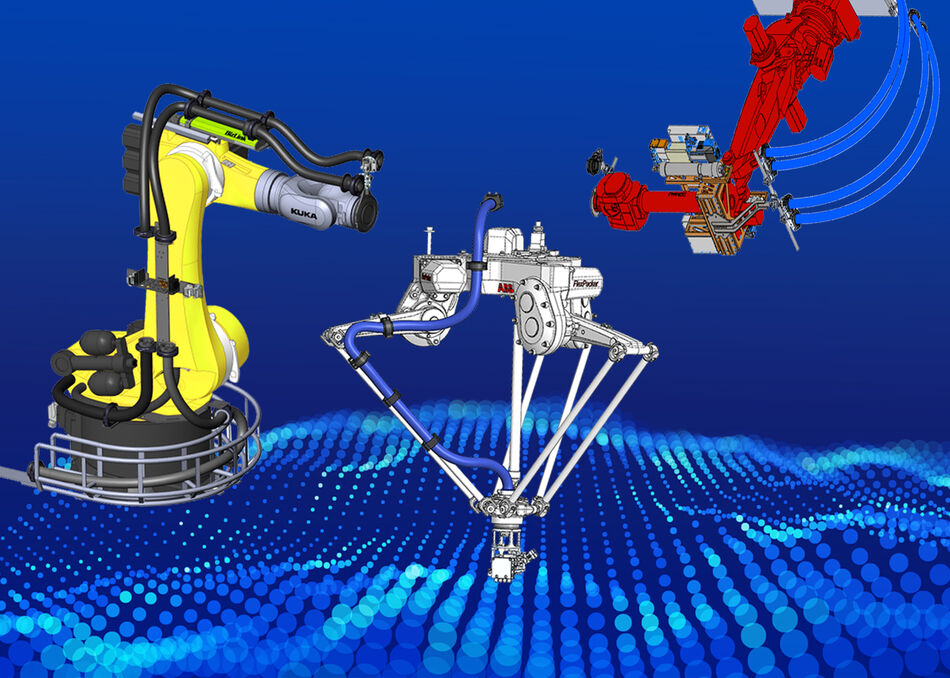
Not every robotic application behaves the same — and not every dresspack should either.
High-force riveting, flow drilling, laser processing, multi-media gluing, aerospace drilling, SCARA pick & place or Delta automation all generate different combinations of motion dynamics, mechanical load, media requirements and spatial constraints.
In these environments, a robotic dresspack system is not a peripheral component. It directly influences uptime, motion stability and long-term durability. Standard cable management solutions are typically designed for average load cases. Specialty robotic applications are anything but average.
Motion Profiles, Process Forces and Media Requirements Define the Design
Application-specific robotic cable management begins with a precise technical analysis of the real operating conditions.
Key design parameters include:
- Robot kinematics and axis configuration
- Torsion and bending cycles
- Tool weight, torque and vibration input
- Thermal exposure
- Type and diameter of media (power, data, pneumatics, cooling, adhesives)
- Installation space and mounting position
- Required range of motion
A riveting system introduces high mechanical forces at the wrist. Flow drilling combines axial force and torque with thermal stress. Laser applications require stable routing of multiple large-diameter conduits. Gluing processes depend on optimized bending radii and clean media separation. SCARA robots generate continuous rotary torsion, while aerospace drilling demands extreme precision and stiffness.
Designing the cable management around these realities — instead of adapting the application to a predefined cable package — defines true application-specific engineering.
The Competitive Advantage of In-House Cable and Hose Manufacturing
Many robotic cable management suppliers depend on externally sourced cables and hoses. This limits flexibility and extends development loops.
By designing and manufacturing our own cables, hoses and conduits in-house, we engineer the complete robotic energy supply system as one integrated solution — from conductor layout to mechanical bracket design.
This vertical integration creates measurable advantages.
Faster Development Cycles Through Vertical Integration
When cable construction and mechanical routing evolve together, iteration cycles become significantly shorter. Engineering adjustments can be implemented directly without external coordination.
For demanding specialty applications, this accelerates project timelines and increases technical precision.
Media-Optimized Cable Design for Complex Robotic Processes
Different robotic processes require fundamentally different cable characteristics:
- High torsion resistance for SCARA systems
- Reinforced mechanical protection for riveting and joining
- Thermal stability for drilling or welding
- Optimized flexibility for high-cycle Delta automation
- Defined bending radii for viscous adhesive media
- Shielded signal lines for sensitive data transmission
Because cable production is internal, conductor design, shielding concepts, jacket materials and hose constructions can be adapted precisely to the application.
The cable design supports the robot’s motion profile — instead of limiting it.
Space-Optimized Routing for Compact Robotic Cells
Specialty automation cells often involve:
- Internal routing through Axis 1
- Side-mounted configurations
- Compact multi-process heads
- Robots installed in confined enclosures
In these scenarios, cable geometry, conduit diameter and bracket positioning must be engineered together from the start. Application-specific routing ensures compact integration without compromising reach, safety zones or service access.
Reduced Interfaces for Increased System Reliability
Every additional interface introduces potential risk — mechanical stress concentration, abrasion, leakage points or electrical faults.
An integrated robotic energy supply system reduces unnecessary transitions and simplifies architecture, especially in multi-media configurations combining power, data, pneumatics and process fluids.
Reduced complexity directly improves durability and long-term reliability.
Robotic Cable Management Systems as a Strategic Component of Automation Performance
Cable management influences far more than routing. A properly engineered robotic dresspack system affects:
- Axis load distribution
- Robot motion behavior
- Tool stability
- Vibration characteristics
- Maintenance intervals
- Overall Equipment Effectiveness (OEE)
In high-cycle production environments such as automotive body-in-white, battery manufacturing or aerospace assembly, even small design weaknesses scale rapidly into downtime and cost.
Application-specific cable management stabilizes performance over millions of cycles — not just during commissioning.
Long-Term Durability in High-Cycle Production Environments
Specialty robotic applications often operate 24/7 under high acceleration and repetitive motion.
Aligning flexibility, torsion resistance and routing geometry with the exact robot kinematics minimizes unwanted mechanical influence and reduces wear.
The dresspack becomes a motion-compatible system component — not a disturbance factor.
Integrated Multi-Media Dresspack Solutions for Multi-Process Robot Cells
Modern automation increasingly combines multiple processes within one robot, such as:
- Handling
- Drilling
- Riveting
- Dispensing
- Laser processing
In these systems, the dresspack becomes a central integration platform. Energy, data, pneumatics and process media must be guided synchronously with robot kinematics while maintaining compact routing and clean separation.
Modular architecture combined with in-house cable expertise enables scalable, service-friendly and robust multi-media solutions tailored precisely to the application.
From Aerospace Drilling to High-Speed SCARA Handling: Proven Across Industries
Application-specific robotic cable management delivers measurable value across industries:
- High-force joining applications such as aluminium spot welding and self-piercing riveting
- Flow drilling with combined torque and axial load
- Laser systems requiring stable large-diameter conduit routing
- Complex multi-media gluing applications
- Aerospace machining with internal Axis 1 routing
- High-speed SCARA and Delta automation with extreme torsion cycles
Despite their differences, all share one principle: the cable management system must be engineered around the process — not selected from a catalog.
Engineering for the Application — Not for the Average
When standard dresspacks reach their limits, application-specific robotic cable management becomes a strategic enabler of performance.
By combining in-house cable and hose manufacturing with system-level mechanical integration, we deliver robotic energy supply systems that:
- Increase uptime
- Reduce interfaces
- Shorten development cycles
- Optimize space utilization
- Stabilize high-cycle production
If your robotic application pushes conventional solutions to their limits, we would be glad to analyze your motion profile, media configuration and installation constraints — and develop a cable management concept engineered precisely for your process.