
Robotic Automation for Cleanroom and Dry-Cleanroom Applications
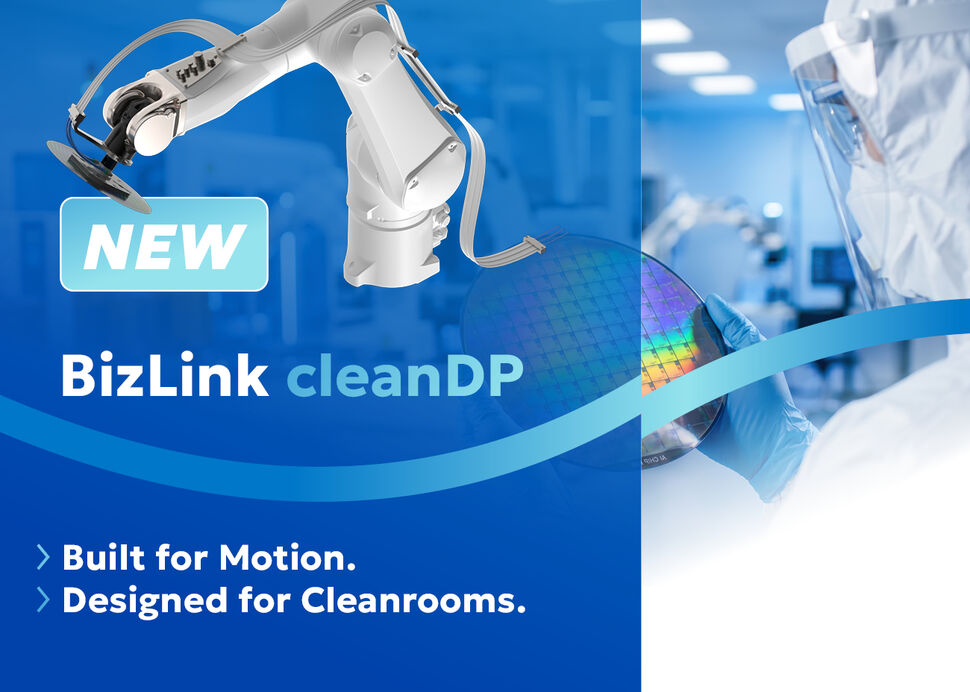
Cleanroom and dry-cleanroom automation places exceptional demands on every moving component within a robotic system. While robots provide the precision and repeatability required for modern manufacturing, the cables and media lines supplying power, data, signals and process media are equally critical to maintaining stable production.
During every robot movement, these components are continuously bent, twisted and repositioned. Without a routing solution specifically designed for cleanroom environments, uncontrolled movement, mechanical stress, abrasion and unsuitable material combinations can contribute to particle emission, contamination risks and increased maintenance requirements.
BizLink develops robotic cable and media routing solutions that support stable robotic motion while helping manufacturers maintain contamination-sensitive production processes in cleanroom and dry-cleanroom environments.
Why Cable and Media Routing Matters in Cleanroom Automation
Industrial robots operating in cleanroom environments rely on a complex combination of power cables, data lines, signal cables and process media to connect the robot controller with the end-of-arm tooling.
Unlike static cable installations, robotic dresspacks must withstand continuous multi-axis movement throughout every production cycle. The routing system must guide all required lines safely while protecting them from excessive mechanical stress and supporting reliable robotic operation.
In contamination-sensitive manufacturing environments, cable management becomes much more than a mechanical accessory. It becomes an integral part of the overall automation concept, contributing to process reliability, maintenance efficiency and contamination control.
Key Challenges in Cleanroom & Dry-Cleanroom Automation
Maintaining Contamination Control
- Particle emission and material outgassing can compromise product quality and make increasingly stringent cleanroom requirements more difficult to maintain. Every moving component within a robotic system has the potential to influence the cleanliness of the production environment. Cable and media routing solutions should therefore be designed using material combinations and routing concepts that help minimise particle generation during dynamic robot movement.
Ensuring Reliable Robotic Operation
- Industrial robots perform thousands of repetitive movements every day. Continuous multi-axis movement places constant mechanical stress on cables and media components, requiring a routing solution that supports controlled cable guidance throughout the robot's complete range of motion. Reliable cable and media routing helps protect critical connections, reduce unnecessary mechanical wear and support stable robotic production.
Supporting Flexible Manufacturing through Flexible System Integration
- Modern cleanroom automation is continuously evolving. Manufacturers regularly introduce new robot platforms, change end-of-arm tooling, expand production lines or modify manufacturing processes. As these systems evolve, cable and media routing solutions must be capable of adapting to new requirements without unnecessarily increasing engineering effort. Robot-agnostic, retrofit-capable and expandable cable management concepts support efficient integration into both new and existing robotic systems. This flexible system integration helps manufacturers adapt cleanroom automation to changing production requirements while supporting long-term manufacturing flexibility.
Typical Robotic Cleanroom Applications
Wafer Handling
Semiconductor manufacturing requires highly precise robotic handling of wafers throughout production and inspection processes.
Reliable cable and media routing supports continuous robot movement while helping maintain the controlled production conditions required for contamination-sensitive wafer handling.
Inspection Systems
Automated inspection systems often combine robots with cameras, sensors and multiple communication interfaces.
Cable and media routing solutions must support high-speed robot movement while keeping power, data and signal connections organised and protected.
Pick-and-Place Automation
High-speed pick-and-place applications demand repetitive, precise robotic movements throughout every production cycle.
A stable routing concept helps guide power, data, signal and media lines reliably while supporting dynamic robot operation in cleanroom manufacturing environments.
Battery & Dry-Cleanroom Automation
Battery manufacturing introduces additional environmental requirements for dry-cleanroom production.
Cable and media routing solutions should be designed to support reliable robotic operation while meeting the specific conditions required for dry-cleanroom automation.
Surface Mounting
Surface mounting processes require accurate robotic positioning together with reliable cable management for continuous production.
Controlled cable routing supports stable robotic motion while protecting integrated cables and media lines throughout repetitive movements.
Robotic Cleanroom Cells
Machine builders and system integrators require routing solutions that integrate efficiently into complete robotic cleanroom cells.
Application-specific cable management supports different robot brands, tooling concepts and media packages while simplifying integration into complex automation systems.
How to Select Equipment for Robotic Cleanroom Applications
- Define the required cleanroom or dry-cleanroom classification.
- Analyse the robot's motion profile.
- Consider all power, data and process media requirements.
- Evaluate maintenance and accessibility.
- Ensure compatibility with the robot and end-of-arm tooling.
- Plan for future production changes and system expansion.
What to Consider When Selecting Cable Management for Cleanroom Robots
Choosing the right cable and media routing solution involves much more than selecting suitable cables.
Manufacturers should consider:
- Required cleanroom or dry-cleanroom classification
- Robot model and available installation space
- Dynamic motion profile and cycle speed
- Power, data, signal and media requirements
- Mechanical stresses during continuous robot movement
- Material behaviour in contamination-sensitive environments
- Integration into new or existing robotic systems
- Future adaptability to changing production requirements
- Maintenance accessibility and service concept
Considering these factors together helps ensure reliable robotic operation throughout the complete system lifecycle.
Why Every Moving Component Matters
Contamination isn't just influenced by the robot itself. It can also be affected by:
- robot joints
- end-of-arm tooling
- cables
- hoses
- protective sleeves
- connectors
- cable routing
- maintenance practices
- robot speed and motion profiles
For this reason, cleanroom automation should always be considered as a complete motion system rather than a collection of individual components.
The BizLink cable management Solution for Cleanroom and Dry-Cleanroom Automation
BizLink cleanDP is a robotic cable and media routing solution developed specifically for cleanroom and dry-cleanroom automation.
The system guides, organises and protects power, data, signal and media lines during dynamic robot movement while helping minimise particle emission in contamination-sensitive production environments.
Built around BizLink's Flexible Sleeve Technology, cleanDP combines low-particle materials with controlled cable routing to support stable robotic motion throughout continuous multi-axis operation.
Its robot-agnostic, retrofit-capable and expandable design supports flexible system integration into both new and existing robotic automation systems, helping manufacturers adapt to changing application requirements.
Frequently Asked Questions (FAQ) About Robotic Cleanroom Applications
What is a cleanroom robot?
A cleanroom robot is designed to operate in contamination-sensitive environments while minimising particle emission during movement. Compared with standard industrial robots, cleanroom robots typically incorporate specialised materials, sealed joints and low-particle design principles to support operation in environments classified according to ISO 14644.
Which industries use robotic cleanroom automation?
Robotic cleanroom automation is commonly used in semiconductor / wafer manufacturing, battery production, electronics assembly, medical device manufacturing, pharmaceuticals, biotechnology and laboratory automation. Industries where product quality depends on strict contamination control.
Why is cable and media routing important in cleanroom automation?
Each process device on the robot requires power, data, signal and often process media to perform its tasks. During continuous robot movements, these components are repeatedly bent and twisted. The routing concept therefore becomes an important part of the overall automation system, influencing mechanical reliability, maintenance requirements and potential sources of particle generation.
What should be considered when selecting robotic equipment for cleanroom applications?
Selection depends on multiple factors, including the required cleanroom classification, robot type, motion profile, available installation space, tooling, cable and media requirements, maintenance accessibility and compatibility with the overall production process.
What is the difference between a cleanroom and a dry-cleanroom?
Both environments control contamination, but dry-cleanrooms additionally maintain extremely low humidity levels. They are commonly used in battery manufacturing and other moisture-sensitive production processes where both particle control and humidity management are critical.
Why are moving components a challenge in cleanroom automation?
Every moving component—including robot joints, cables, carriers and tooling—can contribute to mechanical wear and potential particle generation. Selecting appropriate materials and engineering the movement of these components is therefore an important consideration when designing cleanroom automation systems.
How does automation help reduce contamination?
Automation reduces the need for manual handling in critical production areas. By limiting human intervention and providing consistent, repeatable processes, robotic automation can help improve process stability while supporting contamination control.
How are cleanroom robots evaluated for suitability?
Manufacturers typically evaluate robotic systems using recognised cleanroom testing methods, considering factors such as particle emission during operation and compliance with the required cleanroom classification. Independent testing can provide additional confidence when selecting equipment for contamination-sensitive applications.
BizLink supports manufacturers and system integrators with application-specific cable and media routing solutions designed for contamination-sensitive production environments.
Contact our experts to discuss your cleanroom automation application and discover how BizLink cleanDP can support stable robotic motion, reliable cable and media routing, and flexible system integration.
News: BizLink Introduces cleanDP for Cleanroom & Dry-Cleanroom Automation